Action 2: Divestment
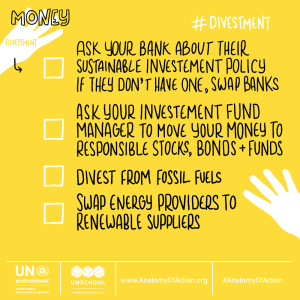
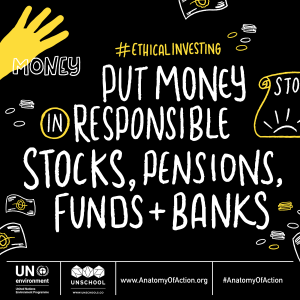
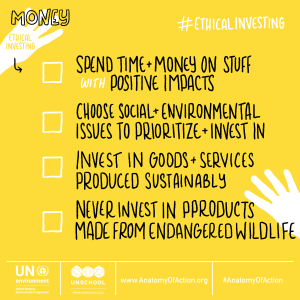
Intentionally investing isn’t the only way to send a message to the market; divestment is another powerful way to share how important sustainability is to you. Divestment happens when people move money away from industries and commercial activities that are unsustainable and instead choose investments, banks, energy providers, and other companies and services that are supporting renewable options, sustainable consumption and production, and development of more sustainable and ethical industries.
Most notably, fossil fuel divestment (inspired by the anti-apartheid movement in South Africa) is on the rise, and as of early 2018, more than 700 organizations from more than 76 countries with over $5.5tn (trillion!) of assets have committed to divesting in fossil-fuel companies and instead will invest in climate solutions.
The needs are clear, with the planet and human health suffering in unprecedented ways — like the fact that unpaid health bills from air pollution due to fossil fuels accounted for US$5.3tn in 2015 (!) — that’s more than global health spending (and by the way, we talk a lot about the impacts of fossil fuels in our Move journal article). The UN has issued multiple warnings and clearly stated in the Intergovernmental Panel on Climate Change’s 2018 report: “Unless humans transform the economy in such a way that has no documented historic precedent, the earth will experience worsening food shortages and wildfires, and a mass die-off of coral reefs as soon as 2040.”
While this cautioning is scary to consider, let a problem-loving approach override the fear, knowing that we all do have individual agency that, when activated for positive sustainable change, adds up to bigger collective shifts.
Make no mistake, as more and more people do this, it sends strong messages to companies to consider their business models and actions to support renewable energy, sustainable technologies, and more responsible products. When it comes to fossil fuels, just 100 companies (all within the oil and gas industry) are responsible for 71% of global carbon emissions — so aiming at divesting from any of these 100 companies can definitely have a large impact. And in doing so, there will be a ripple effect in “creating a new wave of the moral entrepreneur or norm entrepreneur, concerned with labelling a particular behaviour (carbon pollution) as morally reprehensible, and, by so doing, shifting attitudes about climate change mitigation.”