Action 1: Beyond Buying
What’s behind so many of the negative environmental impacts we’re grappling with today? Although there’s no one singular, simple answer, we’d be remiss not to look at the linear economy that we’ve designed over the last century in order to meet human wants and needs. Our current economy is based on a waste-based system of production where we take raw materials and natural resources out of nature, process them into usable goods to meet human needs, and then discard them back into giant holes in the ground that, ironically, were often where we took the raw materials from to begin with.
This entire system is in opposition to the natural systems that sustain life on Earth — which are circular and regenerative — and it’s counterintuitive to the way we function as living organisms. For example, we all require nutrients to survive, which is part of the beautifully-designed system of nutrients cycling through bodies and back into the ground to grow the next generation of food; this nutrient cycle is one of the fundamental ecosystems that makes life on Earth possible. Basically, humans designed a broken system that needs waste to sustain itself, and thus everything is intended to constantly lose value after it’s purchased. Our linear economy does not fit in a circular world, and we can instead find ways of circumnavigating this cycle and activating our agency within the economy by buying better things.
This needs to be emphasized when we start to think “Beyond Buying”, as we cannot sustain the wasteful, reductive linear economy and thus need to transition to a circular economy in order to shift the status quo of our consumption problem. While many people automatically think that transitioning to circular systems design will result in monetary losses, it’s actually the opposite in that a circular economy offers some huge financial incentives. Current research indicates that the material saving potential alone, for example, is estimated at 500 billion € per year for the European industry, and the job creation potential of remanufacturing and recycling in Europe is estimated at one million new jobs!
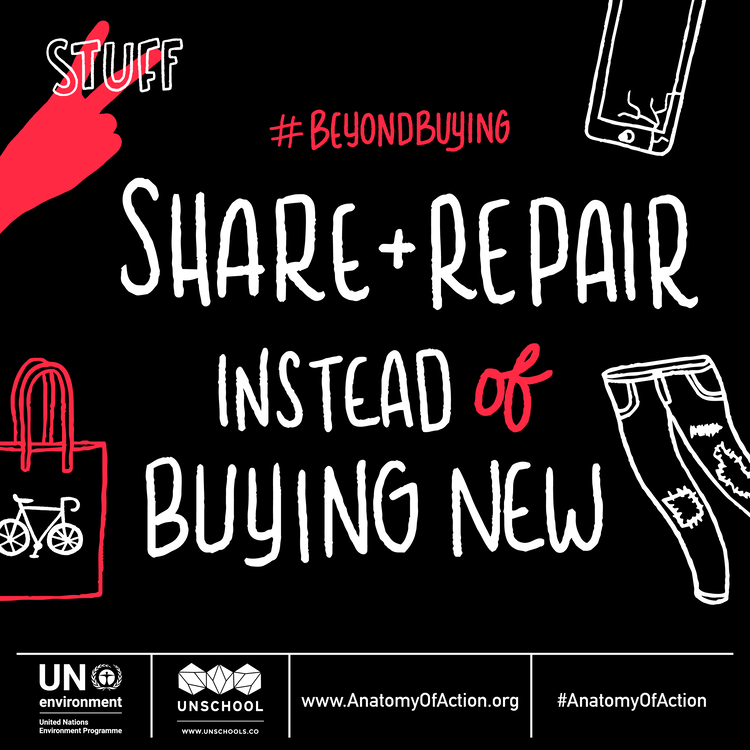
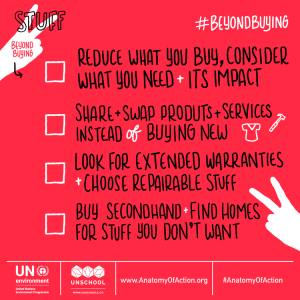
Along with rethinking how we consume stuff and implementing circular design practices, there are also huge opportunities in sharing, swapping, repairing, and repurposing the things that we already have. Consider the fact that on average, cars in North America and Western Europe are only in use 8% of the time, or that the average electric drill is used 6 to 13 min over its lifetime. It makes absolutely no sense as to why we all need to own so many items individually, and it’s much more practical to consider collaborative consumption.
Similarly, we’ve also become accustomed to a throw-away economy in which instead of repairing our goods, we discard them and then replace them instead. This isn’t all the fault of the consumer, however — 77% of EU consumers say they’d rather repair goods than buy new ones, and indeed, there are systems issues with planned obsolescence and enforced disposability that encourage this uptick in buying new devices. This is especially true with tech gear and the trend of replacing smart phones on an annual basis (there are now more phones on this planet than people!), which is a massive missed economic opportunity among its other issues. In fact, a United Nations University report estimates “the value of the recoverable materials in discarded electronics was $52 billion dollars in 2014 alone.” Similarly, if the industry were better regulated and made phones easier to take apart and recapture, then the cost of remanufacturing them could be reduced by 50% per device.
So, as you can see through this small snapshot, there are huge opportunities in moving away from this exploitative economy and moving beyond buying. This is, in short, what the circular economy is all about: meeting our needs with new sustainable product designs, service delivery models, and new approaches to business where we get better experiences with less stuff. To start, we can find ways of introducing things into our daily lives that have more value and last longer, reduce disposability, and maximize material recapture.
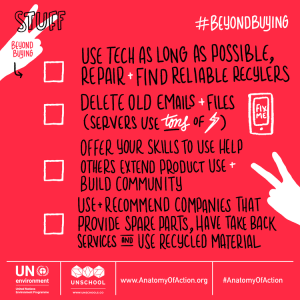
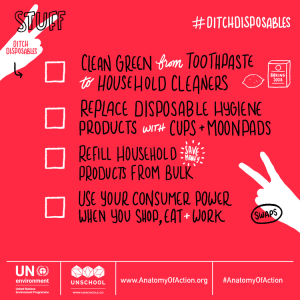
Whilst we wait for all producers of goods and services to adopt these new approaches, consumers of all walks of life can be more conscious of what they need, what they are buying, and how they value the things that fill our lives. Increasing the usable life by repairing, sharing, reselling, and reducing helps reduce the need for new goods. If you can, invest in goods with longer warranties and design durability, and find companies that offer buyback and repair schemes for their products along with swapping and sharing things you need. Consider what you need before you buy products so that you can ensure you acquire things that will last longer, be used multiple times, and are intended to be in the economy for as long as possible before being waste.